Research
Force partitioning approches
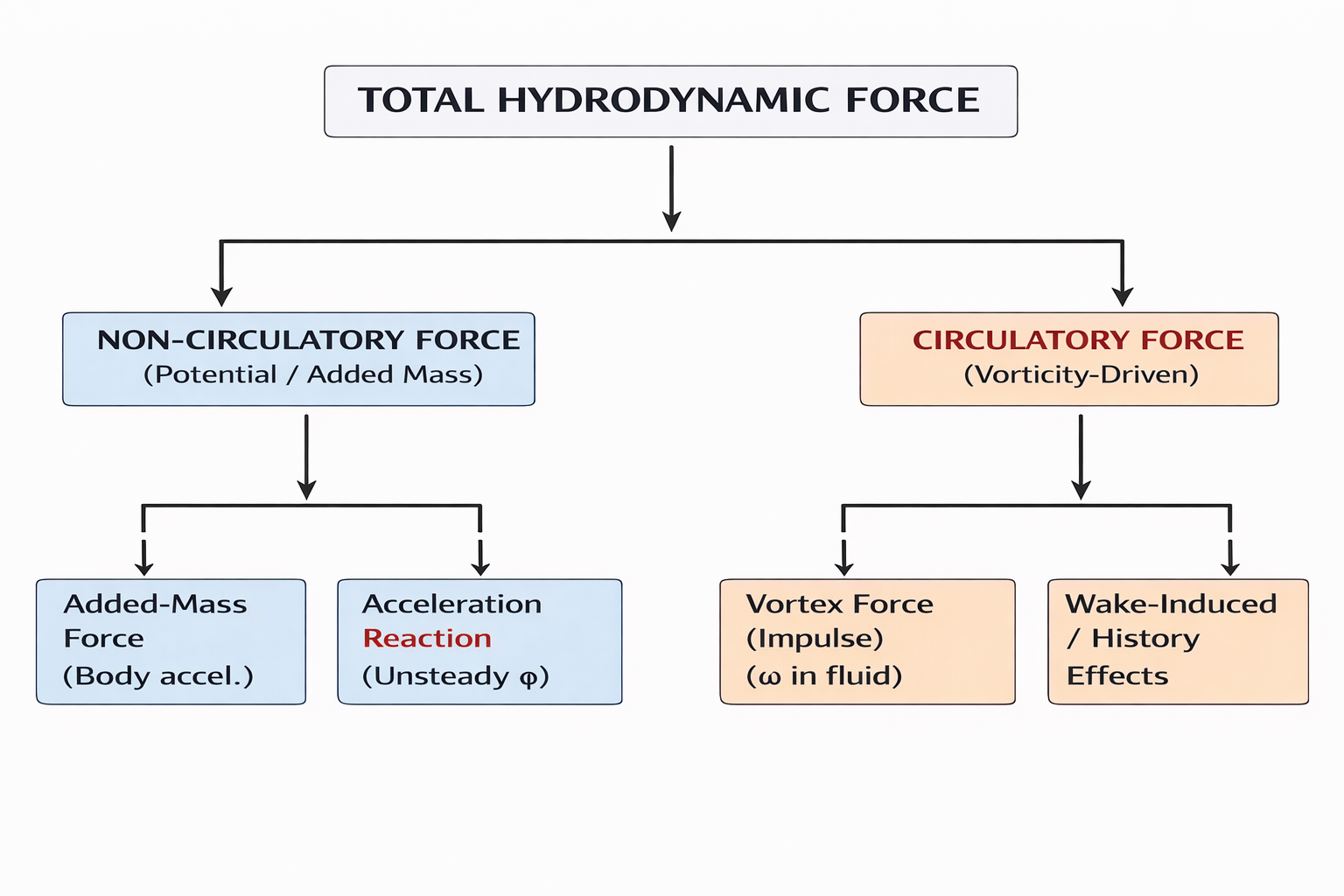
The total hydrodynamic force acting on a body moving in a fluid can be decomposed into non-circulatory and circulatory components. The non-circulatory force arises from potential-flow effects and represents the inertia of the fluid that must be accelerated with the body. This contribution includes the added-mass force, which depends on body acceleration, and the acceleration reaction associated with unsteady variations in the velocity potential. In contrast, the circulatory force is generated by vorticity in the flow field. It accounts for forces produced by boundary-layer vorticity and vortices shed into the wake. The vortex force is commonly expressed using vortex impulse theory, linking force directly to the evolution of vorticity. Wake-induced and history effects further modify this contribution in unsteady flows. Together, these components provide a physically meaningful framework for analyzing force generation in oscillating, swimming, and flying bodies.
Animal biolocomotion and multiple legged motion
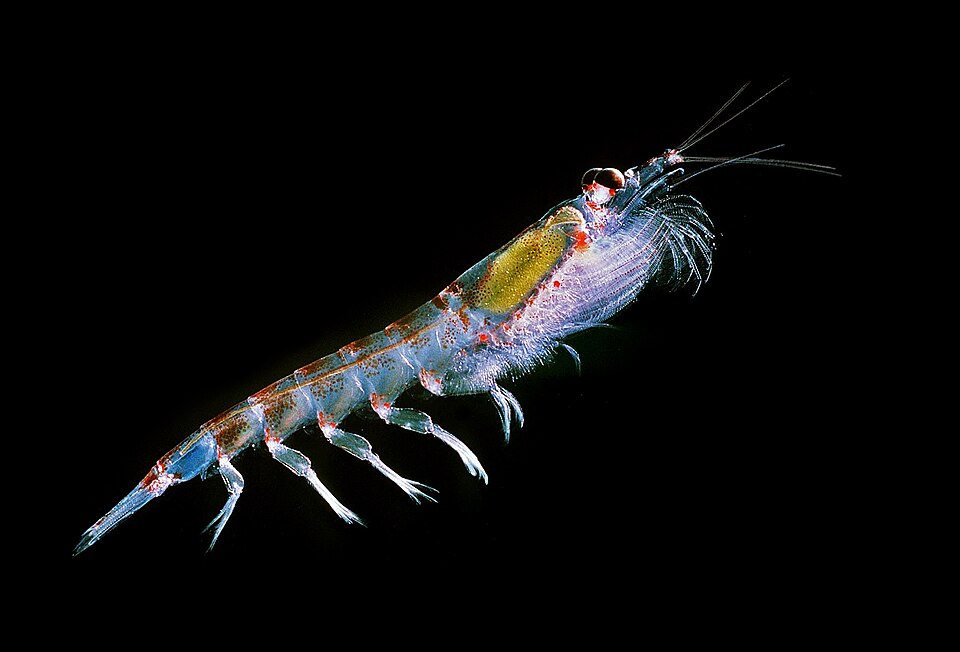
Antarctic krill locomotion is governed by the coordinated motion of multiple pairs of thoracic appendages known as pleopods, which beat in a metachronal sequence to generate thrust. Rather than relying on body undulation like fish, krill swim by producing a series of phase-lagged strokes that create coherent vortex structures in the surrounding fluid. This metachronal gait enhances propulsion efficiency by promoting constructive vortex interactions and reducing energy losses between adjacent appendages. During each stroke cycle, the pleopods generate both added-mass forces associated with appendage acceleration and circulatory forces arising from shed vorticity. The resulting wake consists of interconnected vortex rings that contribute significantly to thrust production. Krill are able to modulate swimming speed, maneuverability, and energetic cost by adjusting pleopod phase lag, stroke amplitude, and beat frequency. This locomotion strategy enables krill to achieve high propulsive efficiency while maintaining fine control in viscous-dominated, intermediate-Reynolds-number flow regimes (Wikipedia: Krill).
Turbulent flow over wavy surface
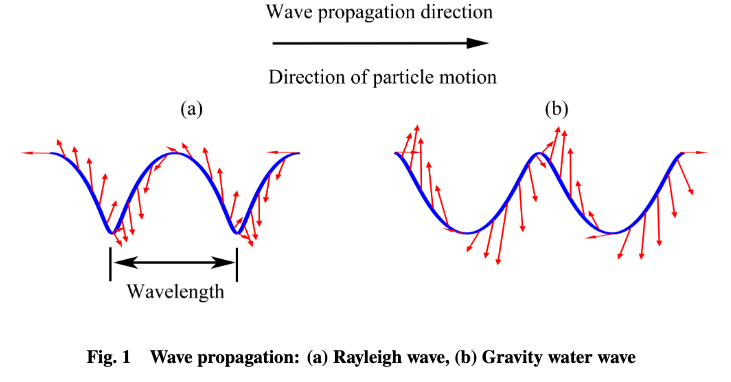
Turbulent flow over a wavy surface exhibits rich, spatially periodic dynamics that arise from the interaction between wall geometry and turbulence. Numerical simulations such as DNS and LES reveal alternating favorable and adverse pressure gradients as the flow passes over crests and troughs, leading to flow acceleration, deceleration, and, in many cases, separation and reattachment. Instantaneous simulated images show coherent vortical structures forming near the leeward side of wave crests and interacting with near-wall streaks, significantly enhancing turbulence production compared to a flat wall. Contours of velocity, vorticity, and turbulent kinetic energy demonstrate strong phase shifts between the surface geometry and wall shear stress. These simulations highlight how pressure forces dominate momentum exchange at higher Reynolds numbers, while viscous effects remain important near the wall. Overall, simulated visualizations of turbulent wavy-wall flows provide critical insight into non-equilibrium wall turbulence and serve as benchmark cases for validating advanced turbulence models.
Reduced-order and Data-drived techniques
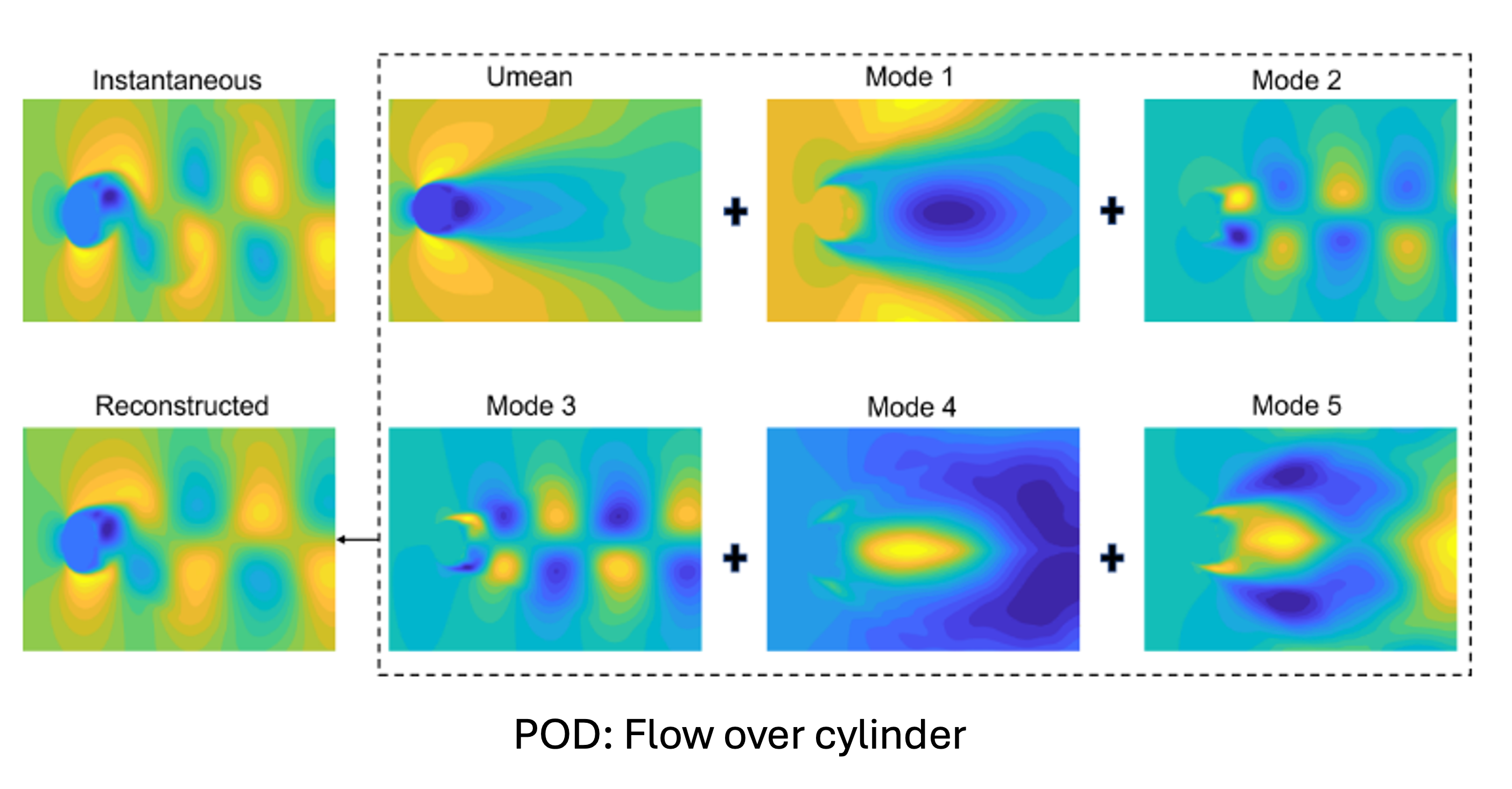
Proper Orthogonal Decomposition (POD), Dynamic Mode Decomposition (DMD), and Spectral Proper Orthogonal Decomposition (SPOD) are widely used modal analysis techniques for extracting coherent structures from complex fluid-flow data obtained from experiments or numerical simulations such as DNS and LES. POD identifies the most energetic spatial structures by decomposing the flow into orthogonal modes ranked by their contribution to the total kinetic energy, making it especially useful for data compression and reduced-order modeling. In contrast, DMD focuses on the dynamical behavior of the flow by extracting modes associated with single frequencies and growth or decay rates, which is particularly valuable for studying unsteady phenomena such as vortex shedding and flow instabilities. SPOD combines the strengths of both approaches by identifying energy-optimal coherent structures at individual frequencies, providing a statistically robust description of broadband turbulent flows. Together, these techniques enable deeper physical insight into turbulence, facilitate model reduction, and support flow prediction and control in engineering and geophysical applications.